
Diamond Brazing and Surface Metallization Services
Diamond Metallization
Diamond Metallization Contract Manufacturing Services
Perfectly Joining Diamond and Metal
Diamond possesses unparalleled thermal conductivity, but its highly inert chemical properties prevent it from being directly welded or integrated with metal substrates for packaging. We specialize in diamond surface metallization processes. Through precision coating technology, we enable diamond thermal management components to be stably and reliably integrated with chips, substrates, and package structures, allowing them to fully realize their thermal dissipation potential.
Why Metallization Is a Key Technology
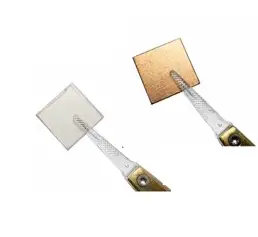
Diamond consists of an sp³ covalent-bond structure, and its surface exhibits virtually no wetting reaction with metals. Without metallization pretreatment, even a high-performance diamond heat spreader cannot be effectively soldered to a chip or substrate. Our metallization process is the essential bridge that transforms diamond from a “material” into an “assembly-ready thermal management component”:
Transition Layer Coating Transition Layer
- Carbide-forming elements such as chromium (Cr) and titanium (Ti) are used to react with carbon atoms on the diamond surface, generating a stable carbide layer and forming strong chemical bonds.
Surface Enhancement Treatment Surface Enhancement
- Additional layers of metals such as Ni, Au, Ag, and Cu can be deposited to improve solderability and oxidation resistance.
Vacuum Brazing / Sintering Vacuum Brazing / Sintering
- Diamond brazing or sintering is performed in a vacuum environment to prevent oxidation and contamination from impurities, ensuring consistent interfaces and efficient thermal transfer.
Applications
Our Process Capabilities
From coating technologies such as vacuum sputtering and electron-beam evaporation to the integration of vacuum brazing and sintering, we provide comprehensive diamond metallization contract manufacturing services. We can also customize transition-layer materials and coating-thickness combinations according to the customer's thermal management substrate specifications.
Product Advantages at a Glance
| Feature | Advantages of Diamond Metallization |
|---|---|
| Bond Strength | Stable chemical bonding for long-term reliability |
| Thermal Conductivity | Reduces interfacial thermal resistance and maximizes diamond's heat-dissipation performance |
| Process | Vacuum processing prevents oxidation and contamination from impurities |
| Application Flexibility | Coating combinations can be customized according to substrate and packaging requirements |
Contact us to learn more about our diamond metallization contract manufacturing services
[ Request a Custom Solution Now ]