

1. Why Does Diamond Conduct Heat So Efficiently?
Diamond has one of the highest thermal conductivities among known solid materials. The key lies in its unique crystal structure and atomic bonding. Unlike metals, which rely on “free electrons” to conduct heat, diamond is an electrical insulator with virtually no free electrons. Heat is conducted primarily by “phonons”—energy fluctuations generated by the vibration of lattice atoms—which travel rapidly through the crystal lattice.
1. Extremely Strong Covalent Bonding
In diamond, each carbon atom is tightly bonded to four neighboring carbon atoms through sp³ covalent bonds, forming a highly symmetrical, extremely rigid three-dimensional lattice. These strong bonds allow lattice vibrations, or phonons, to propagate at extremely high speeds. The stronger and lighter the atomic bonds, the faster the phonons travel.
2. High Debye Temperature
Diamond has a Debye temperature of approximately 2200 K, far higher than that of common metals and ceramic materials. A higher Debye temperature indicates that the lattice can support a broader range of phonon frequencies, maintaining highly efficient phonon transport even at room temperature and minimizing scattering losses caused by thermal vibrations.
3. Low Isotope Scattering and Few Lattice Defects
In high-purity single-crystal diamond, carbon atoms are arranged in a regular pattern and the defect density is low, so phonons undergo less scattering from impurities, vacancies, or grain boundaries as they propagate. This is why the thermal conductivity of “single-crystal” diamond is significantly higher than that of “polycrystalline” diamond—grain boundaries in polycrystalline materials are a primary source of phonon scattering and energy loss.
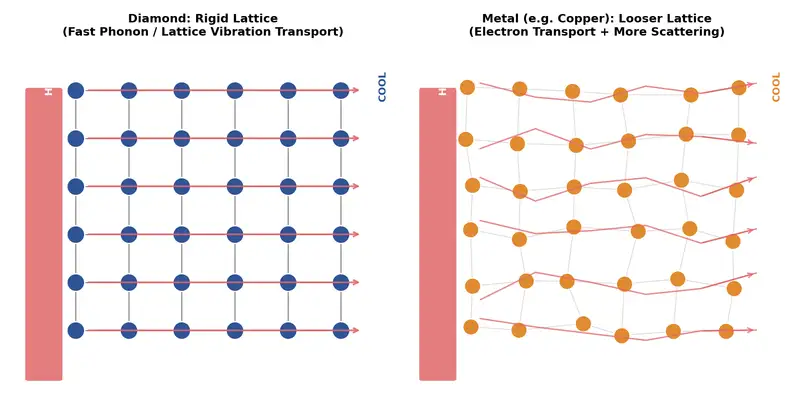
Figure 1: Illustration of heat conduction mechanisms in diamond (left) and metal (right)—diamond transfers phonons through a rigid lattice with regular pathways and minimal scattering, while metals rely on electron conduction and have a looser lattice with more scattering. (Illustration only; not photographs of actual materials)
2. Thermal Conductivity Comparison: Diamond and Common Materials
The table below summarizes the thermal conductivity values of diamond and other common heat-dissipation and engineering materials. It shows that even polycrystalline diamond has far higher thermal conductivity than traditional metal heat-dissipation materials such as copper and silver:
| Material | Thermal Conductivity (W/m·K) | Remarks |
|---|---|---|
| Air | Approx. 0.026 | Reference baseline |
| Water | Approx. 0.6 | Reference baseline |
| Alumina Ceramic (Al₂O₃) | Approx. 30 | Common ceramic substrate for packaging |
| Silicon (Si) | Approx. 150 | Semiconductor substrate material |
| Aluminum (Al) | Approx. 235 | Common heat-sink material |
| Copper (Cu) | Approx. 400 | Industry-standard heat-dissipation material |
| Silver (Ag) | Approx. 429 | Highest among metals, but expensive |
| Polycrystalline CVD Diamond | Approx. 1,000–1,500 | Although affected by grain-boundary scattering, still far superior to copper |
| Single-Crystal CVD Diamond | Above 2,000 | Among the highest of all known solid materials |
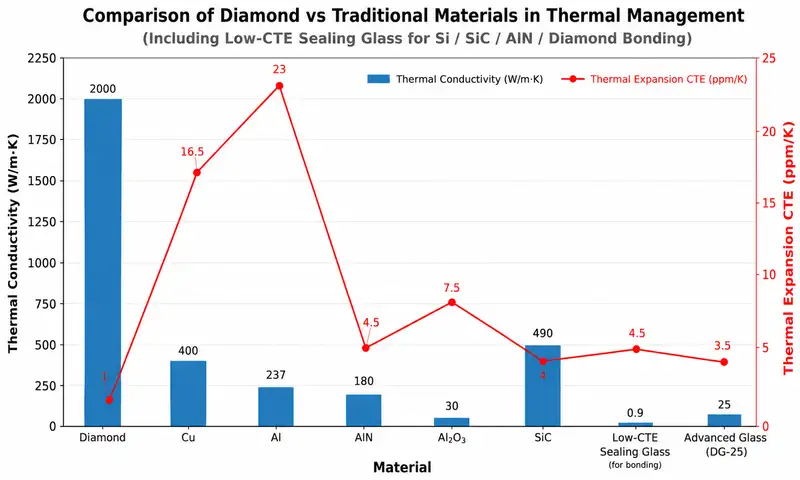
Figure 2: Thermal conductivity comparison chart for common materials (logarithmic scale). Values are typical reference values; actual values vary depending on material purity, crystal structure, and measurement conditions.
3. Application Advantages of Diamond Heat Dissipation
- Rapid heat conduction: Transfers heat generated by high-power components away from the heat source in an extremely short time, preventing localized overheating.
- Excellent isotropy (single crystal): Single-crystal diamond conducts heat uniformly in consistent directions, delivering stable and even heat dissipation.
- Suitable for large-area applications (polycrystalline): Although polycrystalline diamond has slightly lower thermal conductivity, it can be manufactured in larger substrate sizes, balancing cost and coverage area.
- Stable at high temperatures: Its chemical stability enables reliable long-term operation in high-power, high-temperature environments.
- Electrical insulation: Diamond is inherently electrically insulating, making it suitable for semiconductor packaging applications that require “thermal conduction without electrical conduction.”
4. Conclusion
Diamond’s exceptional thermal conductivity fundamentally comes from its structural characteristics of “light atoms + strong bonding + a highly symmetrical lattice”, which enable phonons to transfer thermal energy through the lattice at speeds approaching the theoretical limit. This is why diamond substrates and diamond heat sinks have become essential materials in high-power-density applications such as CPU/GPU devices, laser diodes, and power components—applications in which traditional heat-dissipation materials such as copper and aluminum are difficult to replace.